
Hedge Cutting Datchet Berkshire (SL3) Area: A familiar feature in gardens all around Datchet, hedges can be used for a range of practical purposes, including screening off separate areas, softening the edges of a property and providing definition to an outside space. That said, most hedges need trimming occasionally if they are going to stay at a practical height & spread. Some hedges will need to be clipped more frequently than others, depending on the type, how fast they grow & the kind of finish you would like to achieve.

Cutting a hedge can involve anything from a fairly minor tidy-up to a substantial reduction in height or width. A more formal hedge with even sides and a crisp, level top will usually require more frequent trimming than an informal hedge, where a softer, more natural shape is the preferred option. The amount of clipping needed during the period of active growth can differ quite widely depending on how rapidly the hedge grows, as more vigorous varieties may need several sessions, while less vigorous ones might only need occasional attention.
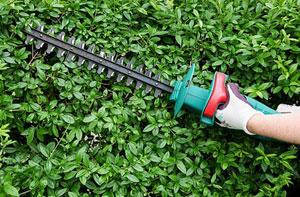
When is the Best Time for Hedge Cutting?
Rather than there being a single time of year for trimming hedges in Datchet, the best timing will vary according to the type, its growing habits and its individual needs. Whether the hedge is only having a gentle cut or undergoing a much more significant reduction of mature growth can have an important bearing, therefore the level of work involved also needs to be taken into account. Before beginning any major work, it is a good idea to consider the particular hedge involved and whether that actual time of year is appropriate for working on it.
Particular consideration should also be given to wildlife during the bird nesting season. Any hedge that's being worked on should always be properly inspected before trimming begins, and any in-use nests should not be disturbed. Where it is difficult to tell whether anything is hiding or nesting in the hedge, holding off on the work until a more suitable time would be the wisest approach.
The Right Time to Cut Your Hedges
Hedges do not all respond to being cut back in the same manner, and some varieties will tolerate certain types of pruning much better than others do. Certain varieties respond well to fairly heavy pruning & can generate new growth from older wood, while others may struggle to recover if they're trimmed back beyond the green outer foliage. Identifying what kind of hedge you're working on can therefore make a considerable difference to how the work should be tackled.
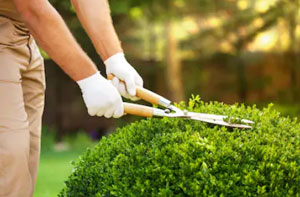
The finished look you're aiming for is another consideration. Instead of being regularly shaped to maintain the precise appearance that are associated with a formal hedge, informal hedges can perhaps be left to keep a less structured form. In either case, the objective should be to keep on top of any unwanted growth without cutting away more than the hedge can comfortably cope with.
A long run or a hedge which is growing on uneven ground can make it much more difficult to achieve a straight, evenly shaped finish. A little planning before getting started with the cutting can help lower the chances of exaggerating any dips, bumps & irregular sections that could otherwise become more apparent if you just trim along the hedge's existing shape.
Rather than allowing the sides to widen towards the top, a formal hedge is generally shaped with a gentle inward taper, making it a bit narrower at the top. Keeping the hedge slightly narrower towards the top can help to create a more balanced shape, while also helping more light to reach the growth lower down. For hedges where a precise finish is particularly desirable, measuring poles, string lines and other basic guides can be used to guide the cutting. This is also one of the reasons why people living in the Datchet area might choose to have formal hedges cut by somebody who has practical experience of achieving neat and uniform finish.
How Access Can Affect the Work
Certain hedge trimming tasks can be reasonably straightforward because the whole hedge can be accessed easily from level ground, but others can be considerably more awkward. It can be difficult to get to hedges that are located alongside fences, walls, sheds, conservatories or steep banks, and especially tall or wide hedges may need to be cut from more than a single position.
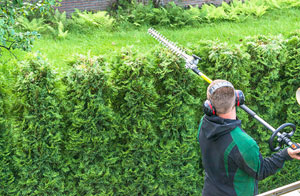
Before starting the job, it's sensible to consider the way that the hedge can be reached safely, instead of dealing with this once the cutting has already got underway. Obstructions, uneven ground & other potential problems alongside the hedge should also be checked for beforehand, especially in cases where they could make manoeuvring equipment more tricky. Extra care will be required when working on a hedge that is situated next to a pavement, roadway or neighbouring property, particularly to make sure the area around the hedge remains safe and keep disruption to a minimum.
Some hedge cutting jobs become much more demanding because of the height of the hedge, and in these situations an experienced hedge cutting company from Datchet can take care of work that may be difficult for the homeowner to manage themselves.
What might seem like a relatively simple hedge cutting job can involve several different types of equipment, especially where there is more substantial growth, restricted access or a sizeable amount of cut material to deal with. Every part of a hedge can't necessarily be tackled using the same equipment, since secateurs may be suitable for individual shoots & lighter growth, whereas thicker branches may require something more substantial, such as a chainsaw or pole saw. According to the height & location of the hedge, suitable step-ladders, platforms or other access equipment might also be needed, while ground sheets can make it easier to collect the large amount of smaller clippings that is produced during the work. Bigger hedge cutting jobs can generate a considerable amount of bulky waste, so a chipper or shredder may be brought in to break down the branches, while leaf blowers & rakes can help get the surrounding area cleared afterwards.
Equipment & Tools for Hedge Cutting
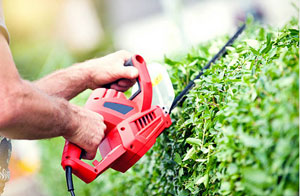
Which tools are needed for hedge maintenance will largely depend on the size and condition of the hedge being worked on. A pair of hand shears can be useful for small sections, fine adjustments and detailed shaping, while powered hedge clippers can make it a lot quicker to cut more substantial areas of less woody growth. Long-reach tools can be useful when cutting higher hedges, although they should still be used from a suitable working position.
When tackling more substantial stems or mature branches, more suitable cutting tools such as loppers or pruning saws may be more appropriate than a regular hedge trimmer. Forcing inappropriate equipment through thick growth can produce a poor finish, while putting unnecessary strain on the machinery could damage both the hedge & the equipment. The right tool for each section of the job can make a significant difference, helping the work to be carried out more quickly, with a tidier result & better control.

Coping With Large and Difficult Hedges in Datchet
There's a considerable differance between giving a hedge its usual seasonal trim and dealing with one that has grown far beyond its desired dimensions, so the latter may call for a different approach. It is worth considering the amount of growth that can reasonably be removed before beginning the trimming, while also considering how the hedge is expected to appear once the job is done. If a substantial amount is cut away from the sides of certain hedges, it can reveal old internal growth that could take a considerable time to green up again.
Where a large hedge has been allowed to grow over a number of years, some of the branches can be surprisingly substantial. Removing these sections in a careful way is generally better than letting heavy pieces fall onto fences, plants or other features below. A carefully managed reduction may be needed when a hedge has to be reduced back to its required dimensions, rather than just treating the work as a regular trimming job.
Dealing With the Waste
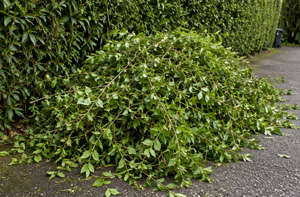
The amount of waste that's produced by even a reasonably small hedge can be more than expected once all the cuttings have been gathered together. Before the immediate area can be thoroughly cleaned up after a bigger job, the mixture of long shoots, thicker branches and fine leafy material left behind will have to be removed.
There's no particular way of dealing with the material, since the most practical option will be influenced by how much has been generated & what disposal facilities are accessible. The smaller amounts of suitable clippings may be easy enough for some Datchet householders to deal with themselves, but greater amounts can need a different way of dealing with them, such as arranging for the material to be taken away. In preference to leaving it until the cutting is in progress to decide how the cut material will be removed, it can be a good idea to sort this out beforehand, particularly where the available space makes removing waste and moving equipment more awkward.
Keeping Hedges From Becoming Overgrown
Sticking to a regular cutting schedule once your hedge has reached the desired height & width can make the cutting needed on following visits much easier. Large amounts of well-established growth should not need to be cut away constantly if the hedge is kept properly maintained, as subsequent cuts can instead concentrate on the more recent shoots sticking out beyond the desired shape.
Different kinds of hedge can benefit from trimming at different intervals, so there's no reason for each and every hedge to be treated according to the same routine. How soon another trimming is necessary can be affected by a variety of factors, including the hedge's growth rate, its variety, weather conditions & how neat it needs to be looking. By paying attention to the hedge after it has been cut, it's possible to get a better idea of how fast new growth develops, which can help work out a practical maintenance interval.
For property owners in Datchet, there may be times when it is more practical to bring in a gardener to deal with the work, rather than trying to deal with it all themselves.
Professional Hedge Trimming Services in Datchet Area
Some property owners in Datchet might be confident trimming more modestly sized hedges themselves, particularly when the whole hedge can be comfortably reached. More substantial hedges, those that have difficult access, substantial branches and jobs that require a precise finish can be alot more involved, however, especially when specialist tools are needed.
How the work should be tackled is something that a competent hedge cutting company from the Datchet area will consider after checking over the hedge and factoring in its species, dimensions, condition, immediate surroundings & the finished appearance that you're hoping to end up with. Each hedge may require a slightly different approach or maintenance routine, which can be particularly relevant when a number of different hedge species are involved.
The amount that needs to be taken from the top section is only one part of planning to do hedge cutting in Datchet, and it's also sensible looking at the hedge in its entirety before working out what work is needed. How the work should be approached will be affected by a variety of factors, including its species, overall shape, how easy it's to get to, the surrounding features & how it is likely to develop in the future. With the right strategy and the most suitable cutting techniques, a hedge can be kept at manageable dimensions while still maintaining the character that makes it a useful part of the garden.
Choosing the Right Approach for Your Hedge
Homeowners in Datchet who would prefer to have someone else carry out the hedge cutting, or who can't do this type of work themselves, can get in an experienced hedge cutting specialist to take care of the cutting on their behalf. By assessing the hedge before the trimming begins, they can get a clearer idea of what is involved & plan how best to carry out the job, including how to deal with difficult access, thicker growth & the resulting waste. For home and business owners with more than one hedge that needs maintaining, getting somebody in to take care of the work can be a useful option, whilst also making it easier to keep individual hedges at the required height or shape.
Nearby:Garden maintenance services are offered in Datchet and also in nearby places like: Stanwell Moor, Chalvey, Hythe End, Colnbrook, Wraysbury, Clewer Green, Longford, Windsor, Eton, Spital, Clewer, Upton, Harmondsworth, Dedworth, Slough, Brands Hill, Langley, and in these postcodes SL3 9QT, SL3 9DJ, SL3 9GL, SL3 9EY, SL3 9NP, SL3 9JA, SL3 9BE, SL3 9DN, SL3 9DW. Local Datchet gardeners will likely have the postcode SL3 and the phone code 01753.
Recognising Problems Before Cutting a Hedge
Diseases and pests do not only cause problems with how a hedge appears; they might also interfere with its growth and make it appear untidy. It isn't always immediately clear when a hedge has a problem, but discoloured foliage, gaps in the growth, dying shoots, unusual markings or poor growth may suggest something is wrong. Many types of hedge can have problems with insect pests such as aphids, caterpillars & scale insects, and they might also be affected by different fungal infections which may leave spots on the foliage, cause shoots to die back or produce other damage. Before removing unhealthy sections of the hedge, it is important to work out what's causing the problem.
What to Consider Before Planting Leylandii
Because of its rapid growth & dense evergreen foliage, Leylandii remains popular for hedges around gardens, offering privacy throughout the year, shelter from the wind & a clear boundary between neighbouring properties. For homeowners in Datchet who are hoping to establish a tall screen reasonably quickly, Leylandii can be a sensible option, particularly where there is enough room for the hedge to develop properly. A major drawback with Leylandii is its rapid growth, as it may put on several feet in a single year when conditions allow, making regular trimming important to manage its height and width. When Leylandii has been left to grow too tall, bringing it back under control may become a difficult job, particularly because older brown growth generally will not fill in again after heavy cutting. When Leylandii is allowed to spread, its thick foliage could reduce the amount of light reaching nearby gardens & take up more space than intended, possibly causing problems between neighbours. Routine hedge cutting may make ongoing maintenance easier, as keeping Leylandii at a manageable size is normally more straightforward than cutting back one which has been left to grow unchecked.
Regular Hedge Maintenance Tasks and Services

Datchet gardeners and hedge specialists can generally help with honeysuckle hedge cutting, careful hedge cutting around established plants & flowerbeds, maintaining hedge shapes around entrances and garden features, wisteria pruning in Datchet, hedge cutting advice, quickset hedging, removing unwanted brambles & ivy from boundary hedges, hawthorn hedge cutting, hedge removal, leaf clearance in Datchet, careful trimming & maintenance of mature laurel hedges, one-off hedge cutting for neglected garden boundary hedges, fancy hedge cutting, regular hedge trimming to keep a neat appearance, help with removing a hedge, hedge thinning & crown reduction, the maintenance of hedges and shrubs, hedge waste recycling, cutting back hedges to improve visibility near driveways, cutting boundary hedges between neighbouring residential garden properties, box hedge clipping, clearing hedge growth around sheds & garden offices and other hedge related services in the Datchet, Berkshire area.
Local Hedge Trimming Enquiries

Recent hedge trimming posts: Brayden Giblin wrote - I'm looking for somebody in the Datchet area to trim the hedge around our garden pond. Warren Gower wrote - We are looking for someone to cut a row of conifers that have grown above the height we originally intended. Leo Preece from Windsor said - We are looking to get two established hedges trimmed & brought into a neater shape. Farah Philip said - Can you clear away the dead branches before giving the rest of our hedge a trim?. Layton Cook wrote - I've got a hedge growing over the pavement that needs cutting back before it becomes a problem for people walking past. Mayson Kay wrote - Our laurel hedge has grown across the inspection chamber and needs clearing back.
 Hedge Care Datchet
Hedge Cutting Datchet
Hedge Care Datchet
Hedge Cutting Datchet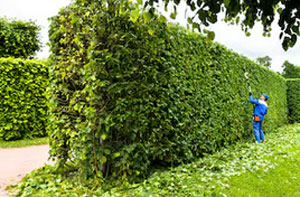 Hedge Trimming Datchet
Hedge Cutting Near Me
Near Datchet you will also find: Colnbrook hedge trimming, Upton hedge pruning, Clewer Green hedge clipping, Upton hedge trimming, Chalvey hedge clipping, Eton hedge trimming, Windsor hedge trimming, Brands Hill hedge cutting, Stanwell Moor hedge trimming, Longford hedge cutting, Brands Hill hedge pruning, Stanwell Moor hedge cutting, Clewer hedge clipping, Langley hedge cutting, Slough hedge clipping, Wraysbury hedge cutting, Clewer Green hedge pruning hedge cutting and more.
More: Seasonal Pruning, Estate Maintenance, Side Trimming, Annual Maintenance, Privacy Hedges, Cut Hedges, Hedge Specialists, Hedge Restoration, Hedge Maintenance, Hedge Thinning, Conifer Trimming, Crown Lifting, Estate Maintenance, Side Trimming, Formal Shaping, Hedge Restoration, Hedge Care, Hedge Planting, Formal Shaping, Cut Hedges.
Specialist hedge cutting in SL3 area, telephone code 01753.
Tree Surgery Datchet, Hedge Cutting Datchet, Hedge Cutting Services, Hedge Clipping Datchet, Hedge Trimming Near Me, Conifer Trimming, Hedge Cutting Near Me, Hedge Planting, Hedge Removal Datchet, Hedge Trimming Datchet, Hedge Cutting Contractors Datchet, Hedge Maintenance Datchet