
Hedge Cutting Bridgend Wales (CF31): Whether they are planted to separate different parts of the garden, soften property boundaries or simply add some definition to an outdoor space, hedges remain a regular sight in gardens right across Bridgend. If most hedges are to be kept at a sensible size and shape, they'll need clipping every once in a while. The sort of hedge, the speed at which it grows and the sort of finish you wish to end up with will all help to determine how often it needs cutting.

Not every hedge cutting job requires the same degree of work, with some only needing a relatively light trim and others requiring a substantial reduction in overall height or width. The structured appearance of a formal hedge often takes more regular maintenance to preserve, whereas an informal hedge can be allowed to develop a less structured shape. The amount of trimming needed during the main growing season can vary considerably according to how rapidly the hedge grows, as faster-growing varieties may call for several trims, while less vigorous ones might only call for periodic cutting.
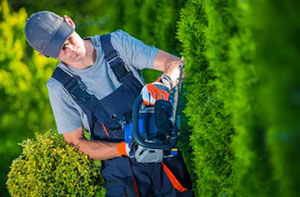
What is the Best Time of Year to Cut Hedges?
Instead of there being a single time of year for trimming every type of hedge in Bridgend, the appropriate timing will be influenced by the species, its growth pattern and its specific needs. Whether the hedge is just receiving a light trim or undergoing a far more considerable reduction of established growth can make a considerable difference, so the extent of work involved also needs to be taken into account. Before commencing any substantial trimming, it's important to establish whether or not that specific time of year is right for the species of hedge that is involved.
Particular consideration should also be given to wildlife during the main bird nesting period. Before any hedge cutting begins, the hedge should be carefully checked for in-use nests, which shouldn't be disturbed. Where it is unclear if anything is hiding or nesting within the hedge, holding off on the trimming until a more suitable time would be the safest option.
When is the Best Time for Hedge Cutting?
How well a hedge reacts to cutting will depend according to the variety, since different hedges can handle varying amounts of cutting. Some species cope well with reasonably severe pruning & can generate new growth from old wood, while others may struggle to recover if they are cut back too far beyond the outer layer of green growth. Due to this, establishing the kind of hedge involved can help you decide the most suitable way to approach the trimming.
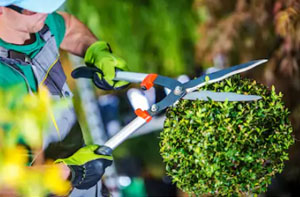
It's also important considering how you would like the hedge to appear once the trimming has been completed. If your hedge is being grown in a neat and formal style, precise attention will generally be necessary to retain its clean lines & even profile, while less formal hedges can perhaps be left to keep more of their natural form. Rather than just taking off as much excess growth as you possibly can, the goal should be to bring under control that growth without going beyond what the hedge can reasonably tolerate.
Even though it might seem fairly straightforward, getting a hedge straight with an even shape can be quite difficult, especially with a long run or when the hedge is situated on irregular ground. A bit of planning before getting started with the cutting can help lower the chances of exaggerating any dips, bumps and irregular sections that may otherwise become more apparent if you just cut along the hedge's existing shape.
Instead of letting the sides to flare outwards, a formal hedge is usually trimmed with a subtle inward taper, making it a little bit narrower at the top. As well as helping to create the hedge a more uniform appearance, this gently tapered shape can help more light to filter through to the lower growth. String lines, measuring poles and other simple guides may be helpful where a particularly even line is required. This is of course one of the reasons why those living in Bridgend will often decide to have their hedges cut by someone who is experienced in achieving a clean and even finish.
How Access and Space Affect the Job
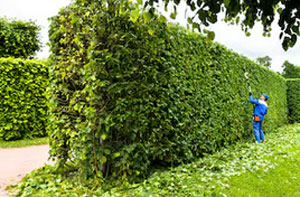
Where the whole hedge can be reached easily from even ground, the job could be reasonably straightforward, although other situations can be alot more tricky. It can be awkward to access hedges that are situated alongside walls, fences, sheds, conservatories or steep banks, and particularly wide or tall hedges may need to be tackled from more than one position.
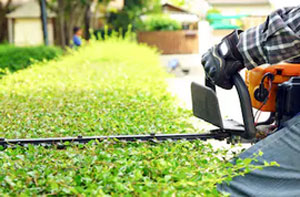
Rather than leaving it until the cutting has begun to decide how to gain safe access to the hedge, this is something that should be considered beforehand. Obstacles, variations in ground level and other potential problems around the hedge should also be checked for beforehand, particularly in situations where they could make carrying equipment more tricky. In places where the hedge is located beside a pavement, road or neighbouring property, it's sensible to take extra care over how the trimming is managed, helping to keep the surrounding area safe and minimise disruption.
For hedges where difficult access makes the work less straightforward, getting a competent hedge cutting specialist in from Bridgend means the homeowner doesn't have to manage the more demanding parts of the job themselves, while the work can be carried out using appropriate equipment.
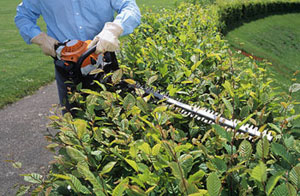
There can be considerably more equipment involved in cutting an overgrown or established hedge than many homeowners might realise, with the hedge trimmer being only one piece of equipment involved in the job. Smaller cuts that need a little more control can often be carried out with secateurs, but heavier stems and established branches may require the use of a chainsaw or pole saw. The equipment that is required is by no means limited to cutting tools, particularly on taller or more awkward hedges; suitable platforms or ladders can provide the necessary access, while plastic sheeting laid on the ground will help prevent smaller clippings from spreading across the area below. The work doesn't necessarily stop once the hedge has been cut, as larger jobs can leave a sizeable quantity of material to remove; shredders or chippers may be used for the bulkier branches, followed by rakes and leaf blowers to finish the clear-up.
Hedge Trimming Equipment & Tools
The condition & size of a hedge will have a bearing on the type of equipment needed for the cutting. The more detailed parts of the cutting can often be dealt with using hand shears, particularly where finishing touches are needed, with powered hedge cutters making more substantial areas of softer growth easier to cut. Long-reach tools can be useful when trimming higher hedges, although they should still be used from a safe working position.
A standard hedge trimmer might not be up to the job when more substantial stems and mature branches need to be dealt with, in which case loppers, pruning saws or similar cutting tools may be more appropriate. If the equipment being used is not appropriate for substantial growth, trying to force it through can lead to a poor finish while also potentially damaging the equipment. Different parts of the job may be better suited to different types of equipment, and making the most suitable choice can help speed up the work while making the cutting cleaner and easier to control.

Dealing With Large and Awkward Hedges in Bridgend
A hedge that has become heavily overgrown may need to be handled differently from one that's simply having its routine seasonal cut. How much material can reasonably be removed should be worked out before the trimming begins, along with the expected shape of the hedge following the cutting. Cutting a large amount from the sides of certain hedges can uncover older inner growth that might remain bare for a considerable time if you are not careful.
Where a large hedge has been left to develop over a considerable number of years, some of the branches can be unexpectedly substantial. Reducing these parts in a controlled manner is a safer option than letting heavy cuttings fall onto plants, fencing or other features below. When a hedge needs to be cut back to its intended dimensions, the work might be better carried out as a planned reduction instead of a normal cutting job.
Clearing Up After Hedge Cutting

A hedge does not need to be particularly big to produce a considerable amount of waste, and this will become more obvious after the clippings have been collected together. The debris left behind after a larger hedge reduction can include anything from fine leafy material and long shoots to thicker branches, and all of this will need to be collected before the area can be thoroughly cleaned up.
How the waste is dealt with will be influenced by both the amount generated & the facilities and options that are on hand. Certain property owners in Bridgend may be able to compost suitable hedge cuttings or manage modest amounts themselves, while greater volumes may need to be chipped, transported or otherwise removed. Planning what will be done with the resulting waste before pressing on with the trimming can be particularly worthwhile where space is limited, as waste & equipment may need to be moved through the area.
Keeping Hedges From Becoming Overgrown
After a hedge has been reduced to the desired dimensions, routine maintenance can help keep it at around that height & width, making following visits a lot more straightforward. Once the hedge is being regularly maintained, later cuts can focus mainly on newer shoots that have sprouted beyond the required shape, instead of cutting away large amounts of older growth each time.
How regularly a hedge needs this maintenance can differ from one kind of hedge to another, rather than being identical in every case. Growth rate, hedge species, the weather and the level of neatness that's required can all have a bearing on when another cut is needed. By paying attention to the hedge after it has been cut, it's possible to work out how quickly new growth develops, which can help determine a appropriate maintenance interval.
Keeping on top of hedge trimming doesn't always mean householders in Bridgend have to carry out all the work themselves, because they can call in a hedge cutting specialist to handle some or all of it.
Professional Hedge Cutting in the Bridgend Area
Some residents in Bridgend may be confident cutting more modestly sized hedges themselves, especially when the whole hedge can be readily accessed. Hedge cutting can become alot more challenging when an accurate finish is required, particularly where specialised equipment is required.
Before working out the best way to carry out the task, a good hedge trimming contractor from the Bridgend area will typically inspect the hedge, considering its type, dimensions, condition, immediate surroundings and the result that you're hoping to end up with. Where a number of different hedge species are being maintained, it's worthwhile to look at each one separately, as the most appropriate approach & trimming schedule will vary from one hedge to another.
A hedge should be viewed as a whole when you are considering hedge cutting in Bridgend, rather than merely focusing on the how much needs to be cut from the top section. Instead of looking at the hedge just in terms of the work that is currently needed, how the job is handled should also consider its type, shape, ease of access, surroundings and how fast it's likely to grow in the future. With a practical game plan & the right cutting techniques, a hedge can be kept at manageable dimensions while still retaining the character that makes it a valuable part of the garden.
Choosing a Hedge Cutting Contractor
For property owners in Bridgend who would rather leave this work to somebody else, bringing in a reliable hedge cutting specialist can mean the job can be left in experienced hands. Instead of simply getting straight on with the trimming, they can assess the hedge first and decide what the job involves, the most suitable approach to take & how any awkward access, heavy growth or green waste will be handled. Where you have several hedges that need cutting, or you're looking to keep them at a certain height, shape or finish, having somebody who knows what they're doing tackle the work can take the hassle out of dealing with the work yourself.
Nearby:Garden maintenance services are available in Bridgend and also nearby in: Brynna, North Cornelly, Tythegston, Aberkenfig, Pen-y-Fai, Pyle, Bryncethin, Coity, Ogmore-by-Sea, Tondu, Brackla, Laleston, Ewenny, Nottage, Cefn Cribwr, Copychurch, Pencoed, Porthcawl, and in these postcodes CF31 1RJ, CF31 1DQ, CF31 1QA, CF31 1TW, CF31 1SP, CF31 1PR, CF31 1LA, CF31 1QQ, CF31 1EJ, CF31 1DE. Local Bridgend gardeners will most likely have the postcode CF31 and the telephone code 01656. Verifying this should guarantee that you are accessing local gardeners. Bridgend householders will be able to benefit from these and many other garden related services. Simply click on the "quote" banner to get info on garden maintenance services in your area.
Identifying & Dealing With Hedge Problems
While some pest and disease problems may to begin with show themselves through changes in the look of a hedge, they can as they develop cause wider problems with the health & growth of the hedge. Not every issue with a hedge is immediately easy to see, but changes to the leaves, shoots or general growth can give an indication that disease, pests or another issue might be having an effect on the hedge. Damage to the stems and leaves can sometimes be caused by pests such as caterpillars, aphids or scale insects, whereas dieback, leaf spotting & other signs of damage may be a sign of a fungal infection. Knowing whether the hedge is affected by pests, disease or another problem can make it more straightforward to decide which growth needs removing & how best to deal with it. Trimming can sometimes make a difference, but the pest, disease or growing conditions behind the problem may also need to be addressed.
Looking After a Privet Hedge
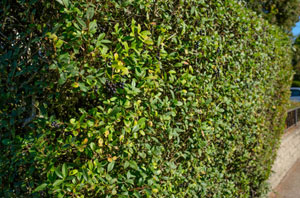
Privet has long been a popular choice for garden hedging since its dense growth can create a neat, well-defined boundary as long as it's properly maintained. Keeping a mature hedge looking neat can involve more frequent trimming than some other forms of hedging, as the new shoots can develop pretty swiftly & will soon spread beyond the required shape. Keeping a privet hedge trimmed on a routine basis can prevent it from growing beyond the intended size, whilst also helping the hedge maintain thick, even growth. Routine trimming might well be sufficient for a privet hedge that's been kept under control, but a neglected one can be a different matter, with thick woody growth sometimes calling for heavier cutting.
 FAQ: Here are a few of the most frequently asked questions about hedge cutting: How do you get the sides of a hedge even? Is hedge cutting charged by the hour or by the job? Can an old hedge be brought back into shape? Can hedges on sloping ground still be cut evenly? Do flowering hedges need to be cut at a particular time? How much can you safely cut off a hedge? Can a gardener cut large or established hedges? How often should a privet hedge be cut?
Hedge Maintenance Tasks & Services

Bridgend gardeners and hedge specialists will likely help you with laurel hedge cutting, maze hedge clipping, flail hedge trimming, commercial hedge trimming, farm hedge cutting, hedge clipping removal, yew hedge cutting, the correct trimming of decorative hedges in Bridgend, domestic hedge cutting, beech hedge pruning, overgrown hedge cutting, general upkeep services, hornbeam hedge pruning in Bridgend, hedge and shrub removal, hedge pest control, commercial hedge cutting, hedge design and planning, griselinia hedge cutting and pruning, hawthorn hedge cutting, hedge thinning in Bridgend, wood chipping, hedge shaping, tree trimming, hedge fertilisation & nutrient management, honeysuckle hedge clipping and other hedge related services in Bridgend, Wales. These are just a handful of the tasks that are carried out local gardeners. Bridgend specialists will inform you of their entire range of services.
Hedge Cutting Services Bridgend
- Hedge Removal in Bridgend
- Hedge Maintenance in Bridgend
- Hedge Trimming in Bridgend
- Hedge Inspections in Bridgend
- Hedge Spraying in Bridgend
- Tree Pruning in Bridgend
- Hedge Tidying in Bridgend
- Shrub Pruning in Bridgend
- Hedge Pruning in Bridgend
- Hedge Height Reduction in Bridgend
- Hedge Shaping in Bridgend
- Hedge Planting in Bridgend
- Hedge Cutting in Bridgend
- Hedge Care in Bridgend
 Hedge Care Bridgend
 Hedge Cutting Bridgend
 Hedge Trimming Bridgend
Hedge Trimming Near Me
In places near to Bridgend you will also find: Ogmore-by-Sea hedge cutting services, Tythegston hedge cutting services, Cefn Cribwr hedge cutting services, Laleston hedge cutting services, Tondu hedge cutting services, Aberkenfig hedge cutting services, Pencoed hedge cutting services, Bryncethin hedge cutting services, Copychurch hedge cutting services, Pen-y-Fai hedge cutting services, Nottage hedge cutting services, Porthcawl hedge cutting services, Brynna hedge cutting services, North Cornelly hedge cutting services, Coity hedge cutting services, Ewenny hedge cutting services, Pyle hedge cutting services, Brackla hedge cutting and more. All of these villages and towns are serviced by local hedge specialists. Bridgend property owners can get price quotes by going here.
Hedge cutting in the CF31 area, phone code 01656.
Hedge Shaping - Hedge Removal Bridgend - Hedge Clipping Bridgend - Hedge Cutting Near Me - Tree Surgery Bridgend - Hedge Trimming Bridgend - Hedge Trimming Near Me - Hedge Cutting Bridgend - Hedge Maintenance Bridgend